

Questions answered
- What makes a buyer credible?
- What counts as proof of funds?
- When should VDR access be granted?
Interested is not the same as credible
A sale process can attract genuine curiosity, exploratory buyers and counterparties ready to mobilise capital. Treating them identically creates two risks: wasted time and premature disclosure.
The answer is not to require a fully committed bank package at the first click. It is to increase evidence as access increases.
Test 1 - Identity and beneficial ownership
FATF emphasises adequate, accurate and up-to-date information on the beneficial owners of legal persons. For a seller, knowing a buyer's trading name is therefore not enough in a sensitive process; the counterparty should be attributable to a person, an organisation and, where relevant, the individuals who ultimately control it.
The depth of verification depends on risk and applicable rules. DealPME does not replace the AML/KYC obligations of banks, lawyers or other regulated professionals.
Test 2 - Decision authority
A person can be properly identified but still lack authority to commit the buyer. Before sensitive access is granted, the seller should understand the contact's role, the proposed acquisition vehicle, who approves, whether a committee or parent entity is involved and whether the person acts for themselves or a third party.
This avoids weeks of negotiation with someone unable to convert interest into a decision.
Test 3 - Acquisition thesis
A credible buyer can explain why the opportunity belongs in its target perimeter: sector, geography, size, business model, capability need, investment horizon and value-creation logic.
The thesis need not be complicated. It should be specific enough to show that the VDR is not being used as free competitive intelligence.
Test 4 - Financial capacity and funding path
“Proof of funds” is often oversimplified. It does not always mean 100% of the purchase price is already sitting in cash. Transactions can combine equity, debt, co-investors, guarantees and seller financing.
The practical question is whether the path from interest to funds at closing can be evidenced. Depending on the stage, evidence may include investment-capacity information, suitable bank evidence, financing plans, fund commitments or proof that a credit process has started. The acceptable form depends on the transaction and relevant advisers.
FATF guidance also distinguishes source of funds from source of wealth in enhanced diligence. The distinction matters: a wealthy buyer may still need to evidence the origin and availability of funds for the specific transaction.
Progressive qualification
| Stage | Proportionate evidence |
|---|---|
| T0 exploration | Account identity and broad preferences |
| T1 interest | Organisation, role, thesis and indicative ticket |
| Before NDA/admission | Stronger identity, authority, capacity and conflict checks |
| Before T2/VDR | Executed NDA + sufficient qualification + owner permission |
| Before credible offer | Funding structure and principal conditions |
| Before closing | Evidence required by banks, advisers and regulated professionals |
Progression also protects the buyer by avoiding excessive collection of personal or financial information before it is necessary.
Red flags should remain signals, not verdicts
Unusual behaviour does not prove bad intent. It may justify further verification: insistence on T2 data before qualification, refusal to explain decision authority, a thesis inconsistent with the target, persistent inability to describe financing, opaque control, or unexplained changes in acquisition vehicle.
The correct response is pause, verify, document and make a human decision.
What DealPME should measure
Credibility should not become a secret score that replaces compliance. Useful indicators are factual: identity verified, authority evidenced, thesis completed, capacity evidence current, response times, offer submitted, diligence opened and outcome declared.
In the governed DealPME baseline, risk admission remains a compliance decision and sensitive access is controlled. AI may assist classification and explanation; it may not admit a buyer or expand permissions autonomously.
Checklist before VDR access
- Identity verified to the required level.
- Beneficial ownership understood where applicable.
- Authority to act evidenced.
- Acquisition thesis coherent.
- Economic ticket/capacity plausible.
- Funding or funding path explained.
- NDA executed.
- Information owner's consent recorded.
- No unresolved regulatory or conflict block.
A credible buyer is not the one making the highest promise. It is the one whose identity, mandate and execution capacity become increasingly verifiable as the process advances.
Credibility should increase with the access requested
Qualification should not be binary. A visitor may legitimately explore a market with limited information. But requesting company identity, detailed financials or VDR access justifies stronger evidence of identity, mandate and financial capacity.
This protects the seller without turning the process into an arbitrary barrier. It also protects serious buyers: an environment where every visitor receives the same sensitive information undermines trust and increases leakage risk.
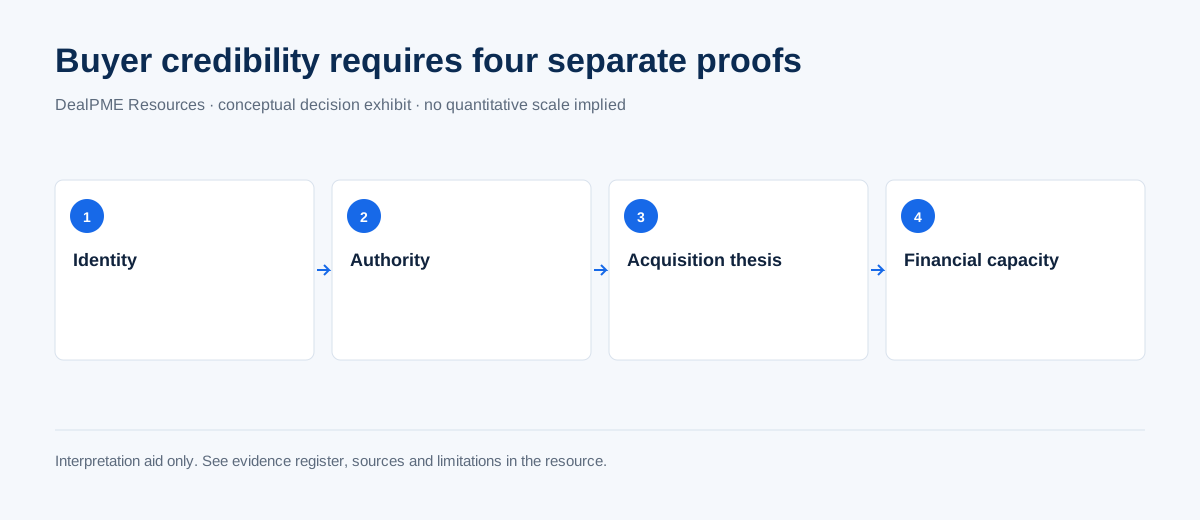
The four dimensions of a credible buyer
1. Attributable identity
Who is the person, which organization does the person represent and who is the beneficial owner where relevant? FATF standards emphasize adequate, accurate and up-to-date information on the true owners of legal persons. That does not make DealPME a financial institution; it provides a useful reference for identity quality.
2. Authority to act
An interested executive may not have authority to bind a group. A fund may require an investment committee. A family company may have several decision makers. Separate personal interest, exploration mandate and negotiating authority.
3. Acquisition thesis
A credible thesis describes what the buyer seeks, why, within which geographic and financial boundaries, and how the buyer expects to own or operate the business. It reduces opportunistic requests and gives the seller context before sensitive information is opened.
4. Documented financial capacity
Capacity does not mean the purchase price is already sitting in cash. Funding can combine equity, debt and co-investors. But the structure should be documented enough to separate a plausible plan from an aspiration. Evidence should be proportional to stage: initial declaration, proof of funds, bank letter, financing indication, investor documentation or other evidence appropriate to the structure.
Signals that require more questions
- requests for T2 information before qualification;
- identity or beneficial ownership that cannot be attributed;
- contact person cannot explain who decides;
- target ticket materially exceeds documented resources without a financing plan;
- thesis changes radically for every opportunity;
- early request for exclusivity without a diligence timetable;
- refusal to provide evidence proportionate to the access requested.
A signal is not an accusation. It should trigger a question, additional evidence or narrower access.
Seller checklist before T2
The seller should be able to see: verified identity, organization, role, thesis, target ticket, expected funding sources, decision makers, timetable, NDA and rationale for the requested access. Exact requirements depend on the transaction and applicable framework.
Buyer checklist for becoming a credible counterparty
Prepare in advance: decision map, short acquisition thesis, target ticket, available equity or mobilization plan, debt/co-investment strategy, approval timetable and the list of people who will need access to the file.
What DealPME can and cannot conclude
DealPME can verify and structure qualification evidence within its governed perimeter, apply access gates and preserve the record. It should not turn those checks into a guarantee that the buyer will finance, close or perform its obligations. Disclosure remains governed by the process and, where applicable, by seller/compliance decisions.
Sources
Ranked by authority. Links open the publisher's site.
This resource explains; it is neither legal, tax or financial advice nor a formal valuation. Have your situation validated by a professional.