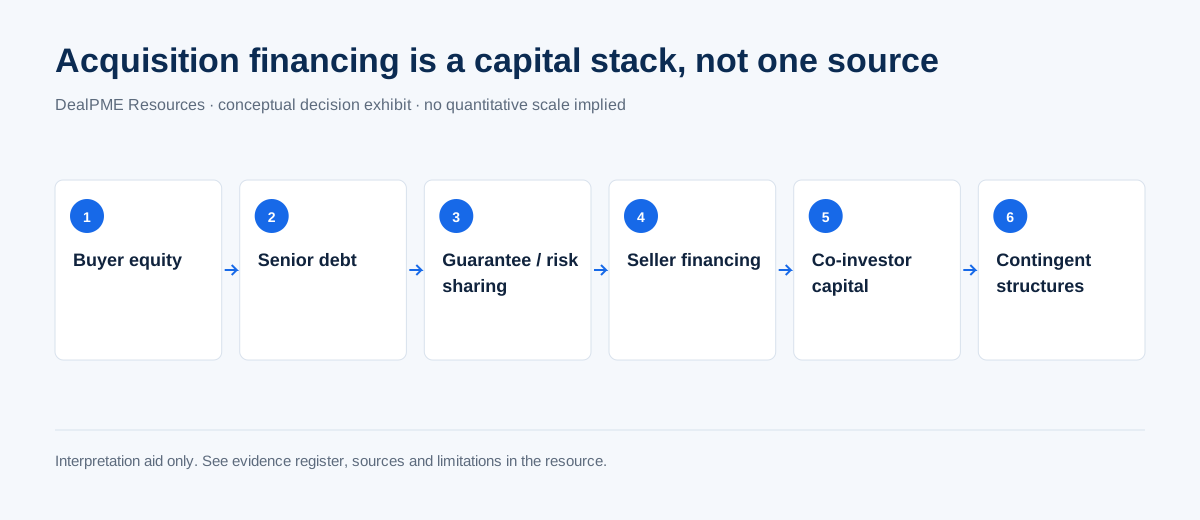
Equity, debt, guarantees and seller finance must be built around sustainable cash flow, not headline price alone.
For
Buyers, diaspora, sellers, advisers
Stage
Finance / Negotiate
Geography
Africa / UEMOA
Framework
UEMOA and national law as relevant
Published 24/09/2026Reviewed 24/09/2026Evidence as of 24/09/20266 min read
Questions answered
Which funding sources can be combined?
How should debt capacity be tested?
What changes cross-border?
Acquisition finance is not ordinary SME working-capital finance
A lender financing inventory faces a different risk from one financing a change of control. In an acquisition, credit analysis must connect the target's earnings and cash generation with the buyer, price, payment structure, security package, integration risk and governance after closing.
The broader SME financing environment remains constrained. IFC and the GPFI cite a $5.7 trillion EMDE MSME credit gap estimated for 2019. That is a broad SME-finance statistic, not a measure of acquisition-finance demand.
In the West African Monetary Union, the BCEAO Banking Commission reported customer credit at CFAF 38,731.6 billion in 2025, up 5.5% over the year. Again, this is aggregate banking credit, not M&A debt. It provides system context but must not be converted into an acquisition-finance market size.
The funding building blocks
Buyer equity
Equity takes the first economic loss and signals sponsor commitment. There is no universal DealPME equity percentage: the appropriate amount depends on risk, cash flow, collateral, price and financing terms.
Bank debt
Depending on market and lender, debt can include amortizing loans, bridge facilities, asset-backed structures or working-capital facilities alongside acquisition debt. Lenders will test debt service, covenants, security and downside resilience.
Guarantees and risk-sharing
Public or development-backed guarantee mechanisms may increase lender appetite for eligible segments. Eligibility is specific; a guarantee does not turn an unbankable transaction into a sound credit.
Seller financing
The seller defers part of consideration. This reduces day-one funding but creates credit risk, ranking, interest, security and potentially post-closing governance questions.
Part of price becomes contingent on future performance. It is not free funding; it reallocates valuation risk and requires precise definitions of metrics, management conduct and dispute resolution.
Co-investors
Family offices, funds, managers or other investors can share equity. That immediately creates governance questions: voting, reserved matters, dilution, liquidity and exit.
Start with sustainable cash flow, not maximum leverage
Debt capacity should be tested against cash after tax, sustaining CAPEX, working-capital needs, normal management cost and resilience reserves. Strong EBITDA does not automatically translate to high debt capacity when working capital or investment consumes cash.
At minimum, test:
central operating case;
revenue or margin downside;
higher working capital;
unexpected CAPEX;
delayed integration;
higher interest cost where debt is floating-rate.
The objective is not to maximize leverage. It is to preserve the target's ability to operate, invest and meet obligations after closing.
Price, structure and funding belong in the same negotiation
A headline price paid fully at closing has different risk from the same nominal price with deferred consideration, seller financing or performance conditions. Offers should therefore be compared on cash at close, debt, timing, conditions, guarantees and residual risk, not on headline price alone.
For sellers, the highest nominal proposal may carry greater payment risk. For buyers, an over-stretched capital structure can destroy the value being acquired.
Cross-border deals add exchange-control and currency questions
Diaspora or foreign-funded acquisitions must consider external financial-relations rules, bank procedures, supporting documents, funding currency and subsequent payment or repatriation mechanics. In the UEMOA, Regulation No. 06/2024/CM/UEMOA is the current external-financial-relations framework; practical application should be checked with banks and qualified advisers.
What a credible funding package should show
buyer identity and capacity;
acquisition thesis;
proposed price and structure;
target financial history;
bridge to available cash flow;
working-capital and CAPEX needs;
base and downside cases;
sources and uses;
proposed security/guarantees;
post-deal governance;
closing timeline;
remaining conditions.
DealPME's role
DealPME can structure evidence, buyer qualification and workflow toward financing partners. It should not be described as a lender, investment adviser or holder of transaction funds. Credit decisions belong to the financing institution.
Limitations
Available instruments, pricing, collateral, guarantees and exchange-control requirements vary by country, lender and transaction. Aggregate banking figures cited here are not acquisition-financing terms.
<!-- ENHANCEMENT_V1 -->
Build sources & uses before negotiating debt
The table should include purchase consideration, debt pay-off if any, transaction costs, closing taxes, working-capital reserve, transition CAPEX and minimum cash. Sources should separate buyer equity, co-investors, debt, seller finance, other instruments and the amount actually available at closing.
This exposes a common problem quickly: the buyer can fund the purchase price but not the business after the purchase price.
What a lender needs to understand
A lender does not finance a multiple; it finances repayment capacity. Credit work therefore focuses on recurring cash flow, customer concentration, cyclicality, existing debt, security, account quality, management, tax, CAPEX, working capital and downside resilience.
Specific leverage or DSCR thresholds vary by lender and deal; this article therefore provides no universal covenant number.
Treat seller finance as real debt
Seller finance may reduce day-one funding needs and align parties, but creates ranking, interest, security, maturity, acceleration, information-right and senior-lender questions. Treating it as a simple payment convenience understates risk.
Financing conditions in the LOI
Sellers should distinguish funding idea, active lender discussion, term sheet, conditional approval and drawable financing. Buyers should not present financing as certain while investment/credit committee or material conditions remain open.
Common failure modes in poorly prepared funding files
Price agreed before debt capacity; equity fully consumed by purchase price; working capital ignored; unavoidable CAPEX deferred; source-of-funds evidence prepared late; management case accepted without downside; existing security discovered late; and FX/correspondent banking addressed in closing week.
A stronger financing sequence
thesis → first look → indicative price → sources & uses → downside model → lender discussions → LOI → diligence → final credit → drawdown conditions → funds flow → close.
Funding should mature with the transaction: not too early on an unqualified target and not too late when the seller needs execution evidence.
<!-- ENHANCEMENT_V2 -->
Financing must remain governable after closing
A structure that can close is not necessarily a healthy structure. Before signing, the buyer should know who produces lender reporting, who monitors covenants, what minimum cash is maintained, how CAPEX is approved and which triggers require early lender engagement. Funding sustainability is measured over the life of the debt, not only on drawdown day.
Compare structures, not only interest rates
A buyer may compare several architectures: more equity and less debt; higher debt with tighter conditions; or lower day-one bank funding through deferred consideration or seller finance. None is universally superior. The trade-off is between cost, risk, flexibility, control and cash-flow resilience.
A lower headline interest rate can be offset by heavier amortisation, fees, security, restrictive covenants or limited prepayment flexibility. Likewise, seller finance can lower day-one bank debt while increasing post-close obligations to the seller. The financing decision therefore belongs in the transaction model, not in a separate procurement exercise.
What should be evidence before credit committee
A credible file normally connects the purchase price to: verified historical performance; a normalised earnings bridge; cash conversion; working-capital seasonality; sustaining and growth CAPEX; debt already in the business; security; tax/social liabilities; customer concentration; management continuity; and base/downside cases.
Where the lender relies on a guarantee programme, the buyer should also distinguish eligibility from approval. A public or development-backed guarantee can share risk; it does not replace the lender's credit decision or the transaction's underlying economics.
Why local banking context matters without becoming a market-size claim
Aggregate BCEAO credit statistics help describe the banking system's scale and direction. They do not tell the reader how much acquisition debt is available, at what price or on which collateral terms. That distinction matters because acquisition-finance data are rarely published in a directly comparable SME series. DealPME content should therefore resist converting broad SME-credit data into an invented M&A funding market.
Sources
Ranked by authority. Links open the publisher's site.