AI in M&A: where it helps and where human judgment must remain
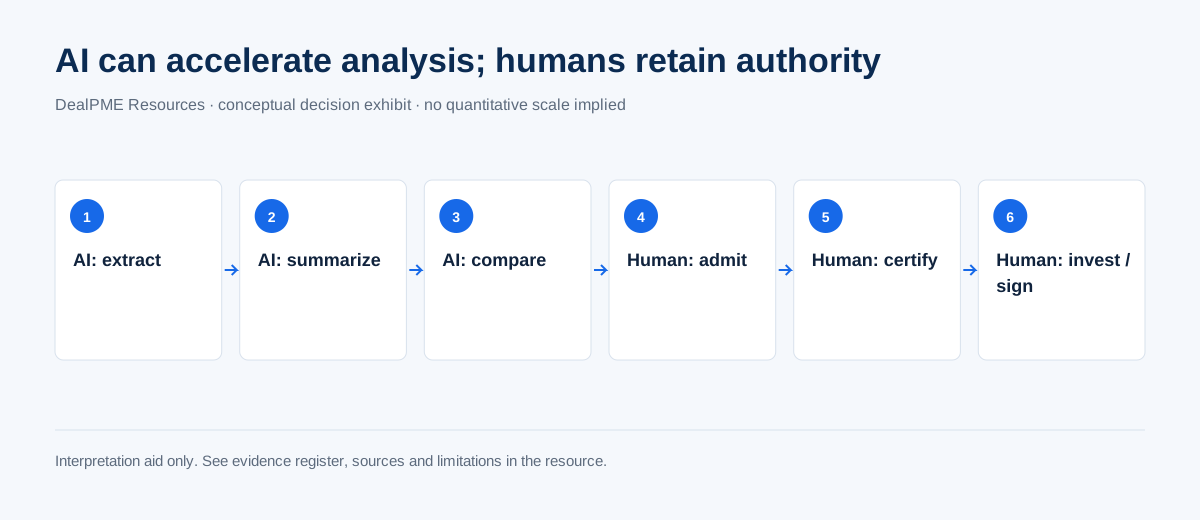
AI creates value when it remains bound to evidence, permissions and explicit human authority.
For
Sellers, buyers, advisers, institutions
Stage
Execute / Govern
Geography
Francophone Africa
Framework
DealPME + AI governance
Published 24/09/2026Reviewed 24/09/2026Evidence as of 24/09/20266 min read
Questions answered
What can AI do in diligence?
Which decisions must remain human?
How do you prevent permission leakage?
Permission comes before capability
The question “what can the AI do?” comes after “what is this user allowed to know?” A VDR assistant must never answer from a document the current user cannot open. That rule matters more than model sophistication.
In DealPME, AI should inherit the current permission context rather than create an alternative route to information. Revoking access must also remove that source from future answers and relevant retrieval indexes.
Where AI creates operational value
Search and classification
Organize documents, find clauses, identify missing items, reconcile versions or detect duplicate questions.
Extraction
Extract dates, amounts, parties, maturities, covenants and structured fields while preserving a link to the source page/object.
Summarization
Compress contracts or Q&A into faster reading, with source drill-back.
Comparison
Compare versions, offers or periods and flag differences; materiality remains a professional or decision-maker judgement.
Drafting
Prepare a diligence question, issue note or first LOI draft. Publication or submission remains an explicit authorized-user action.
Where AI must not become the authority
Certification
Completeness scoring can support preparation; it must not issue an institutional label. Under the governed DealPME baseline, Deal-Ready is a named human CCI decision.
Admission and permissions
AI may explain which gate is missing. It must not open T2, approve VDR access or bypass the RPS.
A model can retrieve a clause or explain a method. It must not present itself as appointed counsel, tax adviser or professional valuer.
Investment decision
Risk summarization is not a recommendation to buy. The acquirer retains the decision and must understand evidence limitations.
Offers and terms
AI may draft. It must not send an offer, change price or accept a counteroffer without explicit action by an authorized party.
Risk management matters as much as the model
The NIST AI Risk Management Framework is voluntary, non-sector-specific and designed to help organizations manage AI risk. Its Generative AI Profile adds considerations specific to generative systems. For M&A, the operational lesson is to govern the use case, know the data, measure quality, document limitations and retain human control where the consequence is material.
An unsupported answer is a lead, not an established fact. When accessible documents are insufficient, the correct response is to say so.
Diligence-specific risks
Hallucination
The model fills a gap with invented content. Control: source requirement and refusal to conclude without evidence.
Permission leakage
A summary reveals information from a restricted document. Control: permission-aware retrieval and leakage tests.
Stale evidence
AI cites a superseded version. Control: versioning, dates, supersession and canonical-source logic.
Automation bias
Users accept a polished answer too readily. Control: confidence, counterevidence and easy verification.
Prompt injection
A document attempts to instruct the assistant. Control: separate trusted instructions from document content and monitor execution boundaries.
Automate, assist or reserve to humans
Activity
AI role
Human / authority role
Summarize contract
Assist
Verify if material
Extract date
Automate + source
Resolve ambiguity
Classify files
Automate under control
Review exceptions
Surface potential risk
Assist
Judge materiality
Grant VDR access
No
Governed permission owner/system
Certify Deal-Ready
No
CCI-Togo
Decide to invest
No
Buyer
Submit LOI
Draft only
Authorized party
The long-term moat is not “having AI”
The defensible advantage is connecting AI to clean, permissioned, dated transaction evidence while preserving human responsibility. A powerful assistant operating on poorly governed data mainly accelerates error.
Limitations
Models, standards and threat patterns change quickly. Sensitive AI functions should be re-reviewed when models, providers, retrieval architecture or permission controls change materially.
<!-- ENHANCEMENT_V1 -->
Design a real human-in-the-loop
“Human validation” should not mean clicking OK after an opaque answer. For sensitive decisions, the reviewer should see the question, sources used, cited passages, documents excluded by permission, uncertainties, deterministic rules applied and proposed action.
The system must also know when not to propose an action because evidence is insufficient.
Anatomy of an acceptable diligence AI answer
Short answer, what the permitted evidence supports.
Confidence, evidence quality, not psychological certainty.
Linked issue, price, SPA, CP, financing, integration or investigation.
Next question, what evidence would reduce uncertainty.
What to test before deployment
Can AI retrieve a revoked file? Does Clean Team segregation survive retrieval? Do citations point to the right version? Can malicious document content inject instructions? Can users distinguish extraction from interpretation? Are sensitive prompts/outputs logged appropriately? Is there a non-AI route for critical work?
Vendor due diligence questions
Ask about data architecture, tenant isolation, customer-data training, retention, localisation, encryption, logs, subprocessors, incident response, models, evaluation, deletion, permission propagation, export and reversibility.
A compelling demo on public documents does not prove security in a live VDR.
The moat is not the model
The same foundation models increasingly become available to many platforms. Durable differentiation comes from permission quality, evidence normalisation, issue taxonomy, version history and the ability to connect an answer to transaction decisions.
AI becomes more useful when the evidence architecture exists before the AI layer.
DealPME responsibility matrix
Task
AI
Authorised human
OCR / classification
automate with controls
monitor exceptions
document summary
assist
verify material points
clause comparison
assist
interpret / decide
VDR access
never decide alone
owner/compliance under rule
certification
never
named institution
offer / LOI
draft
parties submit/accept
legal/tax/value opinion
do not issue
qualified professional
That boundary protects both the user and the credibility of the product.
<!-- ENHANCEMENT_V2 -->
Govern model and vendor change
An acceptable answer today can change after a model update. Sensitive AI functions should therefore preserve model version, date, prompt policy, evaluation sets and release criteria. A model or provider change should trigger permission, citation, hallucination and prompt-injection tests before production use resumes.
Measure quality at task level
A single “AI satisfaction” score hides important failure modes. Measure extraction accuracy, classification, citation correctness, contradiction detection, refusal when evidence is insufficient and permission compliance separately. For tasks influencing price, SPA, CPs or financing, use test cases with expected answers and adversarial counterexamples.
A practical governance loop
MAP the transaction task and decision consequence. MEASURE evidence quality and model behaviour. MANAGE permissions, escalation and monitoring. REVIEW incidents, false positives and user overrides. This is consistent with the risk-management logic in the NIST AI RMF family without treating the framework as a transaction-specific rulebook.
The key governance question is not whether AI can produce a plausible answer. It is whether the system can show when that answer should not be trusted or acted upon.
Procurement should include exit planning
Before adopting an AI provider, define how prompts, embeddings, indexes, logs and derived artefacts can be deleted or exported; what happens when a user revokes a document; whether data are used for model training; and how service termination affects access to prior results. Vendor lock-in is not only a commercial issue when the tool sits inside a confidential transaction workspace.
Human judgement should be concentrated where consequences are high
Not every extraction needs a senior reviewer. The governance model can scale review intensity with consequence. Low-risk classification may be sampled; a clause comparison feeding an SPA issue should be reviewed by the relevant professional; a certification or admission decision remains with the named human authority. That is a more useful design principle than simply declaring that “a human is in the loop.”
Sources
Ranked by authority. Links open the publisher's site.