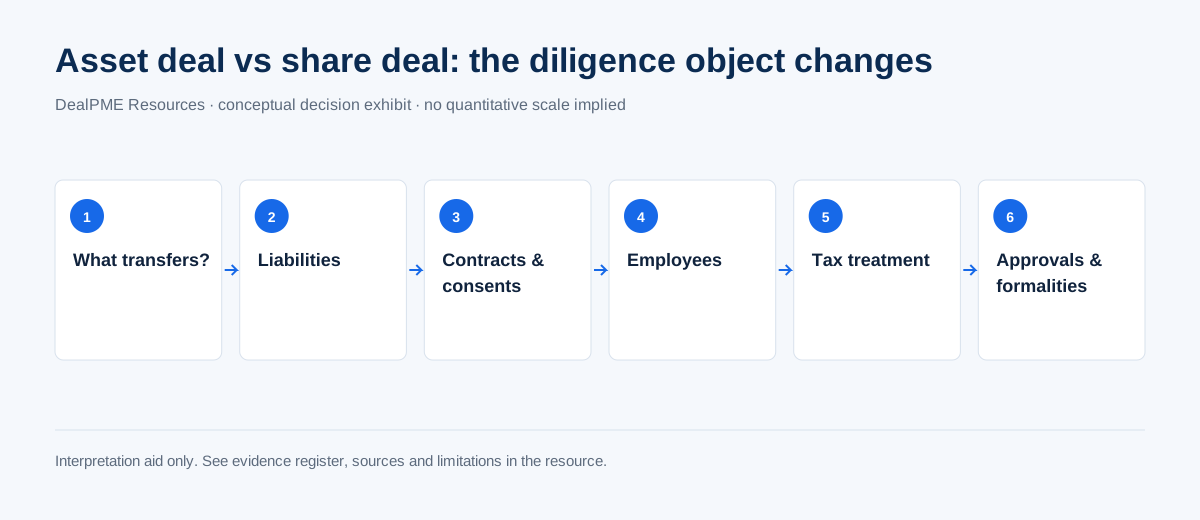
Asset deal or share deal? Understanding the difference in the OHADA area
Transaction structure determines what transfers, what must be diligenced and where residual risk sits.
For
Sellers, buyers, advisers
Stage
Prepare / Structure
Geography
OHADA
Framework
OHADA + applicable national law
Published 24/09/2026Reviewed 24/09/2026Evidence as of 24/09/20266 min read
Questions answered
What is the difference between an asset and share deal?
How does structure change diligence?
When should structure be chosen?
The first question is not price. It is: what exactly is being sold?
Two transactions can provide economic access to the same business while being legally very different. In a share deal, the buyer acquires shares or equity interests in an existing company. In an asset deal, the buyer acquires a defined set of machinery, inventory, brands, business assets, contracts, real estate, receivables or other items within the agreed perimeter.
The distinction matters because a company does not disappear when its ownership changes. A share buyer enters a legal entity with an existing accounting, tax, contractual, employment and regulatory history. By contrast, an asset acquisition requires the parties to identify what moves and what stays behind.
OHADA's AUSCGIE is the core corporate-law framework for commercial companies and covers corporate forms, governance, transformations, mergers, demergers, formalities and publicity. The AUDCG regulates, among other matters, the business undertaking or fonds de commerce and provides a specific regime for its transfer. Not every asset deal is a transfer of a fonds de commerce; legal classification depends on the actual perimeter.
What changes in a share deal
The buyer's diligence centres on the company itself. Key questions normally include:
ownership chain and beneficial owners;
title to the shares or interests;
pre-emption, consent or transfer restrictions;
corporate authority and approvals;
debt, security interests and off-balance-sheet commitments;
licences and permits whose continuity needs to be checked;
obligations to employees and management.
The key point is not to assume that “everything continues automatically”. The team must identify which rights, consents or consequences are triggered by a change of control and which obligations remain with the legal entity.
What changes in an asset deal
An asset deal starts with a perimeter inventory. For each asset or asset class, the transaction team should be able to answer:
Question
Why it matters
What is being transferred?
Prevents an implicit or incomplete perimeter.
Who owns it?
Economic use does not always prove legal ownership.
Is it encumbered or restricted?
Security interests may affect transferability.
Does the contract follow the asset?
Consent or novation may be required.
Is the licence transferable?
Some permissions attach to the entity, not the asset.
Which liabilities are assumed?
Assumed and retained liabilities must be distinguished, subject to law.
What makes the transfer enforceable?
Economic handover and legal effectiveness may not occur at the same moment.
A transfer of a fonds de commerce is subject to a specific AUDCG regime. The official text requires a range of information on the parties, RCCM registration, security interests, certain financial history, leases, price and the assets included. Local counsel should confirm current formalities, national requirements and sector rules.
The legal structure changes the economics too
In a share deal, negotiations commonly distinguish enterprise economics from the value of the equity, with mechanisms that may address debt, cash, working capital, debt-like items and agreed adjustments.
In an asset deal, attention shifts to the value and transferability of the assets, separation costs, essential contracts, working capital included, liabilities assumed and any investment required to make the acquired perimeter stand alone.
Tax consequences can differ materially. DealPME should never present one structure as tax-optimal by default. Country-specific tax analysis belongs to qualified professionals.
Why classification should happen early
A transaction should not reach advanced matching or sensitive disclosure while the legal structure remains ambiguous.
DealPME's governed workflow therefore classifies the transmission mode early and applies the appropriate confidentiality perimeter. This is especially important for share deals: public surfaces should not expose identity, price, terms or VDR content. Disclosure progresses through controlled tiers.
Misclassification cascades into the rest of the deal: the wrong diligence requests, the wrong documents, missed consents, flawed tax assumptions and often the wrong price logic.
A pre-offer decision table
Dimension
Share deal
Asset deal
What is acquired
Equity interest in a company
Precisely defined assets and rights
Entity history
Remains in the acquired entity
Largely remains with seller, subject to transferred liabilities and law
Diligence focus
Legal entity and its obligations
Ownership, transferability and separation of perimeter
Consents
Change-of-control, corporate approvals
Assignment/novation, licences, security interests
Closing
Equity transfer plus conditions/formalities
Coordinated transfer of multiple items
Typical execution risk
Historical liabilities not understood
Perimeter incomplete or key assets/contracts cannot transfer
What to do before choosing
Define the economic objective.
Map the legal structure and asset ownership.
Identify critical contracts, licences and security interests.
Compare financial, tax, employment and regulatory consequences with qualified advisers.
Lock the structure before detailed diligence and offer documentation are built.
Important limitation
This article is a decision framework, not transaction-specific legal or tax advice. OHADA Uniform Acts provide a common legal layer, but tax, employment, exchange-control, sector regulation and some formalities remain country- and transaction-specific.
FAQ
Is an asset deal always safer for a buyer?
No. It may allow a tighter perimeter but can create transferability, separation, consent and licensing problems. Risk changes form; it does not disappear.
Does buying shares mean assuming every risk?
The buyer takes control of an entity that retains its history and obligations. Contractual risk allocation, warranties and indemnities still require negotiation and legal review.
Does DealPME choose the transaction structure?
No. DealPME may structure the workflow and classification process; legal, tax and transaction decisions remain with the parties and their advisers.
How structure changes transaction documentation
The difference between shares and assets continues into definitive documentation. In a share deal, the transaction documents typically need to address the equity being transferred, representations and warranties, purchase-price mechanics, conditions and allocation of historical risk. In an asset deal, the documents must define the transferred assets, excluded assets, assumed liabilities, contracts to be assigned or novated and the formalities required for the buyer to operate the perimeter after closing.
This matters particularly in SMEs where important functions may rely on informal arrangements, founder-owned assets, personal permits or commercial relationships that cannot simply be moved. Diligence must distinguish what the company owns, what it merely uses and what requires third-party consent.
Five structuring mistakes to avoid
1. Choosing the structure only because the price looks simpler. A structure that is simpler economically may create more consents, separation work or regulatory uncertainty.
2. Assuming an asset used by the company is owned by it. Ownership should be evidenced, especially for property, vehicles, trademarks, financed equipment and assets registered to founders or related companies.
3. Treating all contracts as transferable. Change-of-control, assignment and novation provisions can operate differently. Contract review and applicable law come before assumptions about continuity.
4. Using “asset deal” or “share deal” as a tax conclusion. Tax treatment depends on jurisdiction, asset type, parties and structure. An educational framework is not a tax opinion.
5. Deferring the structure decision until after the LOI. An LOI that does not know what is being bought leaves value, financing, diligence and closing assumptions ambiguous.
Questions for advisers before locking the structure
Which entity or assets must legally transfer to reproduce the intended business perimeter?
Are there corporate approvals, pre-emption rights, consents or transfer restrictions?
Which contracts, licences or permits require consent, notice or re-application?
Which security interests affect shares or assets?
Which national formalities supplement the relevant OHADA framework?
Which taxes, duties or employment consequences require modelling?
Which liabilities can and cannot be contractually allocated?
Decision checklist
Before a structured offer is submitted, the file should document: economic perimeter, ownership, chain of title or asset inventory, critical contracts, licences, security interests, liabilities, tax questions for professional review, approvals, formality timetable and closing architecture.
What OHADA texts do not resolve on their own
Uniform Acts provide a common layer but do not replace national rules on tax, exchange control, employment, land, sector licensing or competition. DealPME resources can explain mechanics and evidence requirements; they should not conclude that one structure is legally or fiscally preferable for a live transaction.
Sources
Ranked by authority. Links open the publisher's site.