

Questions answered
- How do I prepare an acquisition remotely?
- What evidence should a buyer provide?
- What does exchange control change?
Remittance data are useful only if they are not misused
World Bank data show remittance flows to Sub-Saharan Africa at $54 billion in 2023. That demonstrates the scale of cross-border household and personal financial links. It does not measure appetite or available capital for SME acquisitions.
The same warning applies to transfer-cost benchmarks. Remittance Prices Worldwide tracks relatively small-value corridors and reported a 6.36% global average in its August 2025 update. That statistic is not an M&A closing-cost benchmark: transaction values, banking controls, documentation and exchange rules are fundamentally different.
The correct conclusion is narrower: diaspora networks can provide future owners, investors and cross-border capabilities, but acquisition requires a different infrastructure from personal transfers.
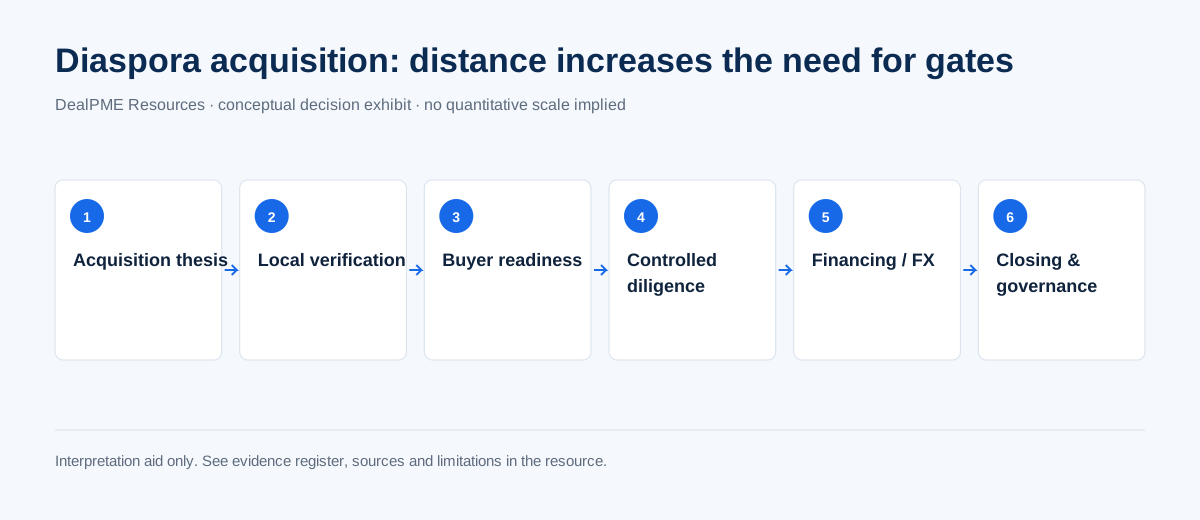
Transition one: turn “I want to invest in Africa” into an acquisition thesis
An unbounded search wastes time and makes targets impossible to compare. Define the countries you can actually operate in, sectors you understand, equity ticket, desired management depth, transformation appetite, control preference, time commitment and strategic or entrepreneurial objective.
The thesis is not a rigid screen. It explains why a target deserves deeper work.
Transition two: establish identity, authority and capacity
Sellers are entitled to know who is asking for sensitive access. A credible diaspora buyer should be able to evidence identity, acquisition vehicle, beneficial ownership, decision authority, source or availability of funds and the financing path where applicable.
This protects both sides: sellers avoid premature disclosure and serious buyers differentiate themselves earlier.
Transition three: build the local team before deep diligence
Distance creates blind spots. Depending on the deal, the team may require M&A advice, legal and tax review, accounting, banking, sector or technical expertise. The purpose is not more advisers; it is to assign questions that software cannot resolve safely.
Professional access should be scoped to purpose, information and duration.
Transition four: separate funding capacity from transfer mechanics
A buyer may have wealth without an executable closing structure. Separate:
- available equity;
- debt or co-investor plan;
- funding currency;
- timing;
- source-of-funds evidence;
- banking channel;
- exchange-control/reporting requirements;
- purchase-price payment at closing.
UEMOA Regulation No. 06/2024/CM/UEMOA governs external financial relations. It does not reduce practical compliance to a single rule: application depends on deal type, country, banks, parties and documentation. Resolve the pathway before closing, not on payment day.
Transition five: conduct remote diligence without turning the VDR into a file dump
Use a sequence: teaser → qualification → NDA → priority documents → management meeting → structured VDR → Q&A → targeted site visit → confirmatory work.
Not all data have the same sensitivity. Named customer data, trade secrets, HR files or security-sensitive information may require more restricted access or Clean Team controls.
Transition six: design ownership before closing
Owning a company remotely is different from wiring capital into it. Before a binding commitment, establish who runs daily operations, reserved matters, physical-presence requirements, banking authority, key-person retention, monthly reporting and first-100-days priorities.
A financeable deal can still fail operationally if governance is improvised.
A seven-gate route
| Gate | Question | Evidence before progressing |
|---|---|---|
| Intent | Why acquire? | Written acquisition thesis |
| Capacity | Can I finance? | Credible equity and funding plan |
| Qualification | Am I an admissible counterparty? | Identity, authority, source of funds |
| Target | Does it fit the thesis? | Documented screening |
| Diligence | Which risks change the decision? | VDR, Q&A, visits, experts |
| Closing | Are funds and formalities executable? | Bank, FX, conditions, documents |
| Ownership | Can I govern after close? | 100-day plan and governance |
DealPME's role
The Diaspora Gateway can organize discovery, qualification, watchlists, meetings and entry into the governed transaction workflow. The investment decision remains with the buyer; regulated services and money movement remain with qualified professionals and authorized partners.
Limitations
Tax, exchange-control, foreign-investment, financing and ownership rules vary by jurisdiction. This is a preparation route, not transaction-specific legal, tax or banking advice.
<!-- ENHANCEMENT_V1 -->
The real cross-border risk: asymmetry of presence
Diaspora buyers may have access to capital or skills, but they see less of the target's daily reality. The risk is therefore operational as well as informational. Who observes cash? Who meets customers? Who checks an asset's physical condition? Who knows that a key manager may leave?
The answer is a presence-governance model: visit calendar, local management, reporting, board structure, signing limits and professionals able to verify physical facts when needed.
Source of funds: prove without overexposing
Sellers, banks or professionals may request evidence of capacity and source of funds. That does not mean personal wealth statements should circulate widely. Keep the rule: evidence proportionate to the gate, secure channel, authorised recipient, controlled retention.
Site visits should test hypotheses
A useful visit is not a courtesy tour. Prepare items to verify: actual production, inventory, maintenance, safety, team presence, physical customer/supplier dependency, equipment condition, site quality, permits and reporting systems.
Separate observation from conclusion. “The plant looks well maintained” is not evidence that future CAPEX is adequate.
Six remote-governance decisions before closing
Who owns the P&L? Who signs payments and within which limits? What monthly reporting? Which decisions are reserved to board/shareholder? How much physical presence from the owner? Who replaces the CEO/CFO if they leave?
These questions should shape the acquisition thesis before the offer, not only the integration plan after closing.
The first 100 days: protect continuity first
A remote owner may be tempted to announce transformation immediately. Early priorities should first protect customers, key people, cash, banks, reporting, authorities, insurance and immediate obligations. Structural changes can follow with better evidence.
Diaspora-specific failure modes
Confusing cultural familiarity with company knowledge; overestimating remote-management capacity; underestimating banking/FX requirements; relying on one local intermediary; leaving post-close governance implicit; mobilising funds late; and agreeing price before understanding working-capital and CAPEX needs.
Diaspora interest in African enterprise ownership is economically meaningful, but transaction discipline remains deal-specific.
<!-- ENHANCEMENT_V2 -->
Build a local verification network, not a local dependency
Remote buyers often solve distance by relying heavily on one trusted person. That can reduce friction but create a new concentration risk. Important facts should be corroborated through different evidence channels: bank records, official registers, customer/supplier evidence where appropriate, independent professionals, site work and contractual documents.
The objective is not distrust. It is segregation of verification: no single intermediary should be able to define the target, control the evidence and validate the conclusion without challenge.
Governance should be designed before the ownership vehicle is finalised
Buyers frequently start with the legal vehicle because it feels concrete. The more important design questions are operating: who will be CEO, how much authority management has, what decisions are reserved, how banking powers work, how budgets are approved and how the shareholder receives timely information. Those decisions then inform the legal and tax structure that professional advisers implement.
Cross-border acquisition has two clocks
The transaction clock covers NDA, VDR, LOI, diligence, financing and closing. The personal/operating clock covers relocation, travel, family constraints, management hiring, banking setup and the buyer's availability. A deal can be technically ready while the owner is not operationally ready. B01 therefore treats execution capacity as a separate readiness test.
Questions before committing non-refundable cost
- Is the acquisition thesis still true after first-look evidence?
- Is the buyer's equity actually mobilisable, not merely part of net worth?
- Can the local management model work if the buyer is absent for several weeks?
- Has the banking/FX route been confirmed by the relevant institution?
- Which facts still depend on one person's word?
- What would cause the buyer to walk away before LOI, after LOI and during diligence?
- Is there enough post-close liquidity after purchase price and transaction costs?
Making these questions explicit early reduces the risk that distance turns into sunk-cost momentum.
Sources
Ranked by authority. Links open the publisher's site.
This resource explains; it is neither legal, tax or financial advice nor a formal valuation. Have your situation validated by a professional.