

Questions answered
- Why are more listings not enough?
- What is transaction readiness?
- Which KPIs matter?
A listing creates visibility; it does not create trust
The instinct in a thin market is often to maximize visible supply: more companies for sale, more visitors, more introductions. Discovery matters, but it does not answer the execution question: can a counterparty take a defensible next decision from reliable information released at the right time?
For SMEs, transaction information is rarely assembled in one place. Financial history, ownership, contracts, tax, debt, licences, founder dependence, customer concentration, litigation, assets and employment records often sit in separate systems or with different advisers. A business can be attractive and still be difficult to diligence. Putting it online increases exposure; it does not automatically make it executable.
IFC's SME Governance Guidebook treats governance as lifecycle-specific and includes an action-planning tool rather than a one-size-fits-all score. The same logic applies to transactions: maturity is created by identifying gaps, assigning ownership and closing them.
Five frictions that stop an introduction becoming a deal
1. The seller's legal and economic identity is unclear
Who owns the business? Which entity signs? What is actually being sold? What approvals are needed? Ambiguity here contaminates every later workstream.
2. Numbers lack provenance
A teaser may show revenue or EBITDA. A serious buyer will ask how those figures reconcile to statutory accounts, management information and adjustments. The issue is not only missing data; it is missing lineage.
3. The buyer is not qualified
A user account is not evidence of decision authority, acquisition thesis or funding capacity. Releasing sensitive information too early to unqualified visitors destroys seller confidence.
4. Confidentiality is treated as a document rather than an architecture
An NDA matters, but it is not enough. The workflow must decide what can be seen before NDA, what requires admission, which documents can be viewed or downloaded, and how access expires or is revoked.
5. Deal work leaves the platform
When introductions move immediately into email and spreadsheets, the system loses versions, Q&A, open issues, offers, withdrawal reasons and timing. Listing volume can rise while the platform learns almost nothing about what actually makes transactions progress.
The right KPI is not registrations
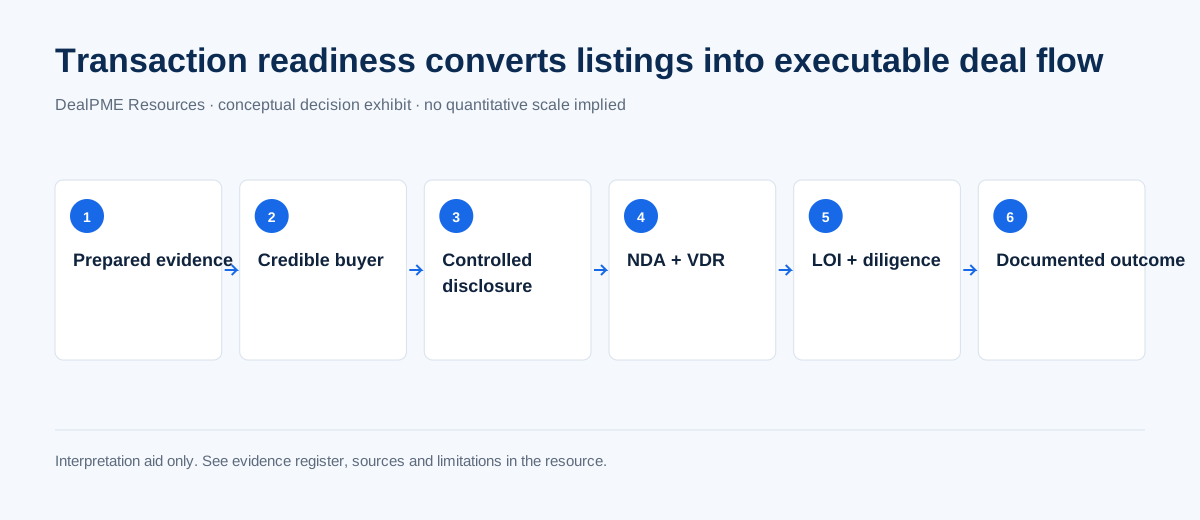
A transaction operating system should follow a funnel with stable definitions: verified mandate, qualified counterparty, executed NDA, VDR access, management meeting, LOI, diligence and documented outcome.
This changes product management. High registrations can coexist with low genuine liquidity. A smaller number of prepared mandates facing credible buyers may create more conversion and more usable operating evidence.
A listing is a unit of visibility. A documented outcome is a unit of learning.
What transaction-ready really means
A transaction-ready SME is not risk-free. It is one whose important facts, dependencies and open issues can be connected to evidence.
| Domain | Readiness question | Typical evidence |
|---|---|---|
| Ownership | Who controls the business and can authorize a deal? | Registry, constitutional documents, title records, authorities |
| Finance | Can the presented numbers be reconciled? | Accounts, trial balances, management data, adjustment bridge |
| Commercial | Where does revenue come from? | Contracts, concentration, sales history |
| Debt / cash | What is the real financial position? | Debt, security, maturities, cash, working capital |
| Legal | Which commitments could affect the transaction? | Contract index, litigation, licences, IP |
| People | Is value dependent on a small number of people? | Org chart, key contracts, compensation, succession |
| Operations | Which assets and permissions are critical? | Asset registers, permits, insurance, maintenance |
| Transaction | What exactly is being sold? | Scope, structure, confidentiality, mandate |
That discipline is separate from Deal-Ready certification. Under the governed DealPME baseline, preparation and remediation precede a distinct human institutional certification decision.
Buyer qualification must be symmetrical
The seller produces evidence; so should the buyer. A balanced system therefore asks an acquirer to establish identity, authority, thesis, ticket, timeline and financial capacity at the appropriate stage.
This symmetry reduces two forms of waste: sensitive disclosure to weak counterparties and prolonged conversations with parties that cannot execute.
Why the issue matters in Francophone Africa
There is no single African transaction market. Legal implementation, adviser depth, banking capacity and company-data quality differ by country and sector. But transaction friction becomes more expensive when deals cross jurisdictions, involve diaspora capital, depend on local financing or start with poorly normalized historical data.
The opportunity is therefore not to copy a foreign classifieds marketplace. It is to make the local chain of proof and decision more legible: identity, governance, financial information, confidentiality, professional review, financing and formalities.
What DealPME should prove before claiming a market moat
Five evidence families matter:
- qualified supply, mandates with clear ownership and perimeter;
- credible demand, buyers with documented thesis and capacity;
- progression, NDA, VDR, meeting, LOI and diligence conversions;
- outcomes, completed, withdrawn or failed deals coded with evidence;
- learning, cycle times, recurring gaps, failure reasons, sector demand and observed behavior.
Future transaction intelligence should not be marketed as an existing moat. It becomes defensible only after clean, real and sufficiently anonymizable outcomes accumulate.
What each participant should do now
A seller should prepare evidence before maximizing exposure.
A buyer should define thesis and capacity before asking for sensitive access.
An institution should measure progression, not only account adoption.
DealPME should optimize for preparation → qualification → NDA → diligence → outcome, using listings as an entry point rather than the definition of success.
Limitations
This article describes an operating architecture. It does not prove that DealPME already has transaction liquidity or a proprietary comparable database. Those advantages must be earned through documented transactions, not asserted in advance.
<!-- ENHANCEMENT_V1 -->
How to measure readiness without creating a misleading score
A company is not transaction-ready simply because 82% of a checklist is complete. One missing critical licence, shareholder dispute or unreconciled debt item can matter more than twenty perfectly filed administrative documents.
A useful view combines completeness, evidence quality, gap criticality and remediation time. The operating dashboard should therefore distinguish what exists from what can change price, delay an LOI, block VDR access or prevent closing.
| Dimension | Weak metric | Better metric |
|---|---|---|
| Documents | files uploaded | critical evidence verified / missing |
| Finance | EBITDA entered | reconciliation to accounts + adjustment quality |
| Buyer demand | page views | qualified buyers reaching NDA / meeting |
| Diligence | pages viewed | critical issues open / resolved |
| Conversion | registrations | mandate → NDA → VDR → LOI → DD → outcome |
An imperfect but transparent file can be more executable than a “complete” one whose contradictions emerge late.
Different actors own different parts of readiness
The seller owns declared accuracy and evidence preparation. The buyer should establish thesis, authority and capacity before seeking disproportionate access. The adviser converts gaps into questions, remediation and deal protections. The institution may confirm or certify only within its governed scope. The platform orchestrates permission, evidence, state and audit; it should not hide human accountability behind automation.
When should the business go to market?
The trigger is not perfection. It is the point at which authority to sell is clear, headline economics are traceable, material gaps are known, confidentiality is classified, remediation owners exist and the company knows what can be shown at each disclosure tier.
Waiting for perfection can waste time. Going too early can transfer preparation cost to buyers, increase withdrawals and damage trust. The operating rule is: prepare enough to explain, then deepen evidence as counterparty commitment increases.
What the platform should learn from every outcome
Completed transactions create useful evidence, but withdrawals can too if reasons are coded. At minimum distinguish price, funding, evidence quality, governance, legal/tax risk, management, timing, strategy change, competition, fit and failed conditions.
That information becomes proprietary intelligence only when definitions are stable and the evidence can be used within permission/privacy constraints. Until then, it should not be marketed as a moat.
Committee questions before investing in more supply
- What share of new mandates reaches evidence quality sufficient for a credible teaser?
- How many genuinely qualified buyers exist per mandate?
- Where is conversion lost: before NDA, before VDR, before LOI or in diligence?
- Which readiness gaps repeat and can be fixed upstream?
- Are advisers receiving cleaner files or merely more files?
- Does the system capture withdrawal reasons, or does learning disappear into email?
Those answers determine whether catalogue growth is actually increasing transaction liquidity.
Sources
Ranked by authority. Links open the publisher's site.
- Multilateral SME Governance Guidebook
This resource explains; it is neither legal, tax or financial advice nor a formal valuation. Have your situation validated by a professional.