Transaction readiness means making facts, risks and evidence understandable - not pretending they have disappeared.
For
Sellers, owners, advisers
Stage
Prepare
Geography
Francophone Africa / OHADA
Framework
OHADA + relevant country
Published 24/09/2026Reviewed 24/09/2026Evidence as of 24/09/20266 min read
Questions answered
What evidence should a seller prepare?
Does Deal-Ready mean risk-free?
How is preparation different from certification?
Deal-ready does not mean perfect
A profitable, growing company can still be difficult to acquire if ownership records are unclear, management numbers do not reconcile to accounting records or critical contracts have never been centralised.
Conversely, an SME can have genuine operating or commercial risks and still be transaction-ready when those risks are identified, documented, explained and, where necessary, supported by a remediation plan.
For DealPME, the distinction is explicit. Transaction preparation is a process; Deal-Ready certification is a separate human institutional decision. The governed P06 workflow runs from diagnosis and evidence through gaps, remediation and pre-review to a CCI-Togo decision. No automated score may create certification on its own.
What evidence serious buyers usually need
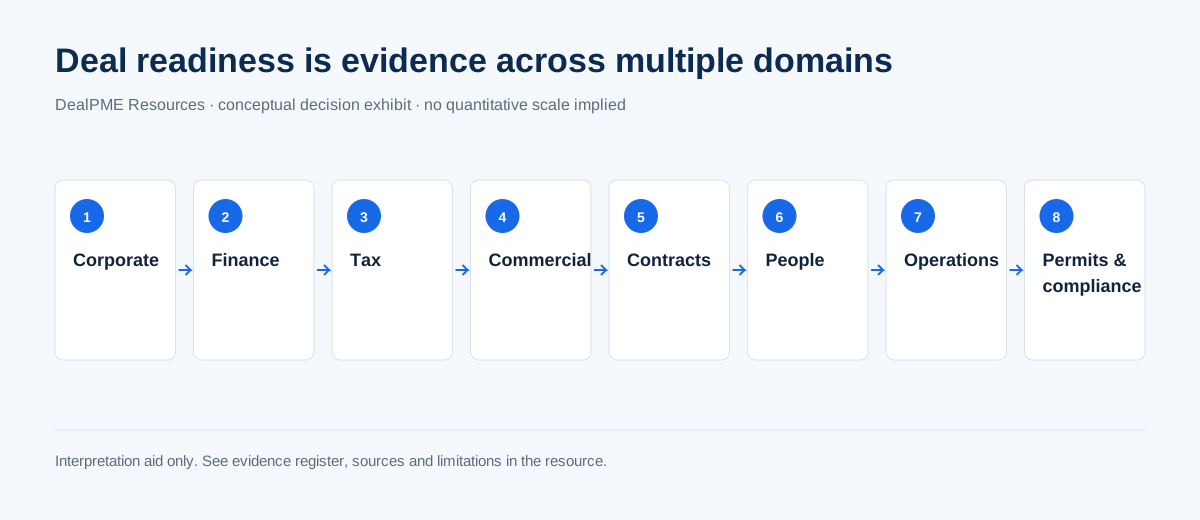
The exact request list varies by sector, size and structure, but eight evidence families recur.
1. Legal identity and ownership
The buyer needs to know which legal entity is being assessed, who owns it and who can authorise the transaction. AUSCGIE provides the corporate-law framework in the OHADA area, while RCCM information supports legal identification and publicity.
2. Financial statements and traceability
AUDCIF and SYSCOHADA form the accounting baseline in the OHADA area for entities within scope. In a transaction, a set of annual accounts is not enough on its own. Numbers used in the teaser, management presentation or model should be traceable to financial statements, ledgers or underlying management records.
3. Debt, cash and working capital
A profitable business can still consume cash. Buyers therefore examine debt, security interests, maturities, seasonality, receivables, inventory and payables.
Total revenue is only the start. Customer concentration, recurring revenue, contracts, channels, payment terms and commercial dependencies affect how sustainable the number is.
5. Contracts and obligations
Customer, supplier, lease, financing, distribution, IP, insurance and partnership agreements should be indexed. The immediate goal is not to issue a legal opinion, but to know what obligations exist and which ones require professional review.
6. Management and owner dependency
In an SME, value can be closely tied to the founder. Buyers need to understand which relationships, decisions, sales or operating knowledge would disappear if the owner left quickly.
7. Assets, licences and operating capacity
Key assets, facilities, equipment, permits, software, systems, maintenance and capex should be understandable. A critical asset that is not owned, a permit that may not continue or deferred maintenance can alter transaction economics materially.
8. Risks and open issues
The file should distinguish verified evidence from management assertions, contradictory records, unreconciled calculations and items requiring professional validation. A single completion score hides these differences.
Better evidence language than complete/incomplete
Useful statuses include:
missing evidence;
uncorroborated management assertion;
contradictory evidence;
unresolved calculation;
professional validation required;
verified evidence;
authorised human judgement;
available but not releasable at this stage.
That language prevents a common mistake: treating the existence of a document as proof that the underlying question has been resolved.
Governance matters because transactions test the organisation
IFC explicitly tailors governance tools to SMEs and family/founder-owned businesses. The connection to transaction readiness is practical: clearer ownership, responsibilities, information and decision rights make a company easier to assess and transition.
This does not mean importing listed-company governance into every SME. The proportionate question is whether critical decisions and information are structured enough to survive diligence and a possible change of control.
Transaction readiness versus Deal-Ready certification
Transaction preparation
Deal-Ready certification
Organises evidence, gaps and remediation
Institutional status under applicable criteria
Can begin before a sale mandate
Follows a sufficiently complete file
Led by the company and advisers
Human decision by the competent institution
May conclude “not ready yet”
May be granted, refused, renewed or withdrawn
Is not a guarantee of sale
Is not a guarantee of sale either
What a seller should do before going to market
Appoint a preparation owner.
Build one document index.
Reconcile transaction numbers to source records.
Map critical dependencies and contracts.
Open a gap register instead of hiding missing items.
Design the disclosure perimeter before buyers are invited.
Route legal, tax and valuation judgements to qualified professionals.
What preparation does not prove
It does not prove value, absence of liabilities, buyer financing capacity or successful closing. It turns an opaque file into an analysable one.
A transaction-ready SME is not a company with no problems. It is a company whose facts, risks and evidence can be understood without constant reconstruction.
How a buyer converts documents into conviction
A serious buyer does not request documents to complete a checklist. The buyer is testing a chain of logic: can the headline numbers be reconciled, is performance durable, are rights held by the correct entity, are risks identified and are the people who can explain them available?
A prepared company helps the buyer move faster because each important answer can be traced to evidence. A revenue figure links to accounts or management analysis; an asset links to title evidence; a material contract links to an executed version; a licence links to its date, scope and expiry.
Preparation does not eliminate diligence. It prevents diligence from being consumed by reconstruction of the basics.
Four levels of evidence maturity
Level
What the buyer sees
Transaction consequence
Asserted
statement without linked evidence
low confidence and rework
Documented
evidence exists but is not reconciled
contradictions remain possible
Reconciled
evidence connects to the stated number/perimeter
more efficient analysis
Remediated
gap identified with owner and corrective plan
risk becomes explicit and governable
This is an operating framework, not a certification score.
Gaps worth fixing before going to market
The goal is not to eliminate every imperfection. Priority should go to issues that could undermine authority to sell, make a key figure indefensible, block access to information or create avoidable closing risk.
Examples include an incomplete ownership chain, unreconciled debt, a critical unsigned lease, major assets owned by a related person, missing customer contracts, extreme founder dependency without a transition plan, an expiring licence, undocumented litigation, or teaser metrics that cannot be bridged to the accounts.
Transaction readiness is not certification
Within DealPME's governed model, transaction readiness makes the file usable for a transaction. Deal-Ready adds diagnosis, remediation and a separate institutional decision. The governed P06 process assigns certification to CCI-Togo and requires a named human decision. Automation may organize evidence; it must not issue the label by itself.
Decision checklist before approaching buyers
The owner should be able to answer: who owns what? who has authority to sell? which numbers will be shown and where do they come from? what dependencies are critical? which contracts or licences can affect transfer? which open issues are already known? who will answer diligence questions? what information may be disclosed at each stage?
What preparation cannot guarantee
It does not guarantee price, buyer interest, financing or completion. It improves the quality of the evidence and the ability of the parties to decide. Valuation and risk acceptance remain separate transaction judgements.
FAQ
Must every gap be fixed before going to market?
No. Separate blockers from issues that can be disclosed, accepted, priced, remediated during the process or allocated contractually.
Does certification mean a company is automatically saleable?
No. Certification has a defined scope. Transaction readiness and economic attractiveness are distinct questions.
Can a VDR open before readiness work is complete?
It can, but an early room full of poorly indexed or contradictory documents may create more questions than confidence. Staged opening is usually more controlled.
Sources
Ranked by authority. Links open the publisher's site.