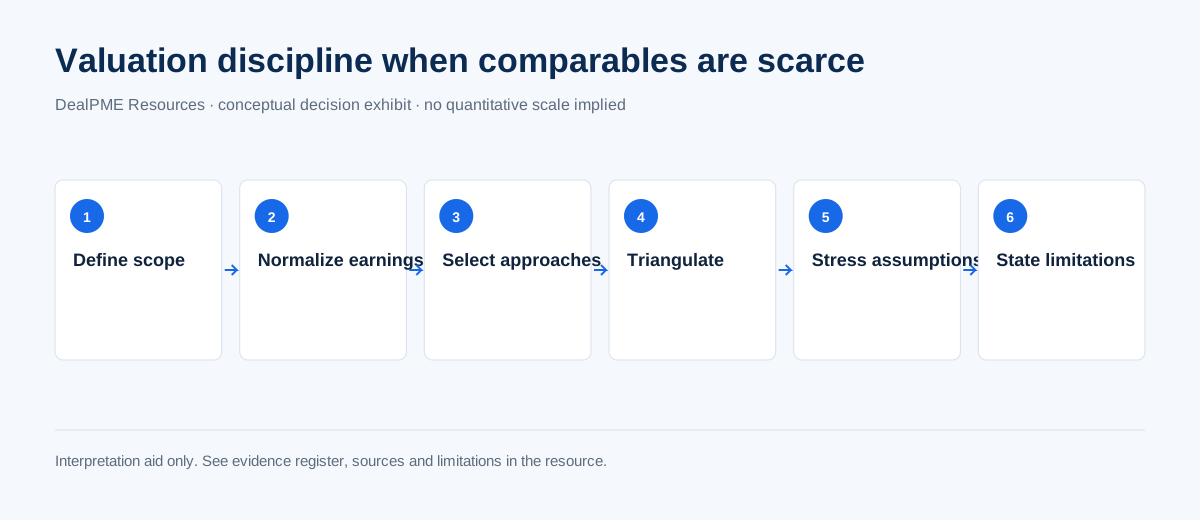
Scarce comparables require more, not less, discipline on assumptions, methods and limitations.
For
Sellers, buyers, advisers
Stage
Prepare / Negotiate
Geography
Francophone Africa
Framework
International valuation discipline + local law
Published 24/09/2026Reviewed 24/09/2026Evidence as of 24/09/20267 min read
Questions answered
How do you value with scarce comparables?
What is the difference between value and price?
How should EBITDA be normalized?
A multiple is not evidence by itself
In a market with few disclosed transactions, the natural question is “what EBITDA multiple applies?” The answer is rarely portable. Public comparables and foreign transactions can differ in size, growth, margin, business model, country risk, governance, financial reporting, capital structure and timing.
A number does not become relevant simply because it is available. Weak comparability can produce a precise-looking but fragile conclusion.
IVS requires valuation work to address scope, basis of value, approaches, data and inputs, models, documentation and reporting; IVS 200 addresses businesses and business interests specifically. Even an indicative exercise benefits from this architecture because the reasoning becomes auditable.
Discipline one: define the object
Before a formula, establish:
enterprise or equity interest;
valuation date;
currency;
basis and purpose of value;
non-operating assets, liabilities or items treated separately.
Confusing enterprise value with equity value can matter more than the selected multiple. The bridge depends on debt, cash and debt-like or cash-like items as defined for the transaction.
Historical accounting profit is not always the right economic baseline. SMEs may contain personal, exceptional or related-party items; some required post-deal management costs may also be understated when the founder performs several roles.
Normalization should therefore be line-by-line and evidenced:
What normal management cost is required after the deal?
Exceptional costs
Are they genuinely non-recurring?
Related-party items
Are terms arm's length?
Family-owned property
What economic rent continues?
One-off revenue
Can it reasonably recur?
CAPEX / maintenance
Does earnings quality reflect sustaining investment?
The objective is not the highest adjusted EBITDA. It is a number the counterparty can reproduce.
Three approach families; none is automatic
Income approach
A discounted cash-flow approach can help when the business plan is sufficiently coherent. But conclusions are sensitive to growth, margin, investment, working capital, risk and discount-rate assumptions. Greater uncertainty calls for scenarios rather than a single-point answer.
Market approach
Public-company or transaction comparables can be useful only after a comparability test: size, growth, profitability, business model, geography, governance, capital structure and date. A thin dataset should be described as thin.
Asset approach
Asset methods may matter for capital-intensive businesses, holding structures, property-rich companies or restructuring situations. They may understate a profitable going concern whose value depends on customers, know-how or other intangibles.
A range is often more honest than a point estimate
A disciplined indicative conclusion can use a range:
downside case with weaker operating assumptions;
central case supported by history and evidence;
upside case only where the required drivers are demonstrable.
The range itself is decision information: it reveals where uncertainty sits.
Do not invent a mechanical discount for every weakness
Relevant value drivers can include customer concentration, founder dependence, management depth, recurring contracts, critical asset ownership, regulatory exposure, financial-reporting quality, CAPEX, working-capital volatility and supplier concentration.
A common mistake is turning each weakness into an unsupported “one turn of EBITDA” discount. Without robust market evidence, that is made-up precision. A better approach is to reflect the issue in assumptions, scenarios, deal conditions or diligence requirements.
Price is not the same thing as value
A valuation is an estimate under a defined basis, date and set of assumptions. A price is negotiated by parties with different synergies, funding constraints, strategies and timetables.
Funding capacity can cap what a buyer can pay without changing every underlying quality of the business. A strategic acquirer may also pay for synergies a different buyer cannot realize.
DealPME's boundary
DealPME may educate on methods, structure data and, under its governed conditional architecture, provide an indicative range with named methods and visible sources. That output must not be represented as a formal DealPME valuation opinion. Where professional valuation judgement is required, a qualified expert should own it.
Checklist before accepting a valuation number
[ ] Object, date and currency are clear.
[ ] Earnings normalization is evidenced.
[ ] Growth and margin assumptions are explicit.
[ ] Debt, cash and working capital are handled separately.
[ ] Comparable limitations are disclosed.
[ ] A downside case has been tested.
[ ] Value, price and payment structure are not confused.
[ ] The conclusion states uncertainty rather than hiding it.
Limitation
This article explains valuation discipline. It does not value a company or recommend a price. Transaction-specific inputs and professional judgements require appropriate review.
<!-- ENHANCEMENT_V1 -->
Build a valuation file another professional can reconstruct
A defensible valuation should be reviewable by someone who did not build the model. Preserve the subject being valued, date, basis of value, cap table, historical financials, adjustments, forecast, growth/margin assumptions, CAPEX, working capital, debt/cash, comparable sources, exclusions and sensitivities.
Classify assumptions as OBSERVED, MANAGEMENT_CASE, ADVISER_ADJUSTMENT, MARKET_INPUT or SCENARIO. This prevents a management forecast from quietly becoming “market evidence”.
Country risk should not become an arbitrary discount
Scarce-data markets often tempt analysts to add one broad country adjustment without explaining the mechanism. A stronger approach links risk to the input it actually changes: inflation, FX, debt cost, collections, tax, logistics CAPEX, disruption probability, growth or a documented discount-rate component.
A single discount can look sophisticated while hiding the economic driver. Ask instead: which specific risk changes which assumption?
Transaction price also depends on structure
Even a well-supported value range does not predict final price. Control, buyer competition, funding certainty, exclusivity, earn-outs, seller finance, warranties, net debt and working-capital mechanisms redistribute economics and risk.
Valuation informs negotiation; it does not replace it.
Questions for a valuation professional
What basis of value are you using and why?
What is the valuation date?
How were historical earnings normalised?
Which comparables were rejected and why?
How are size, liquidity and control treated?
Which assumptions drive most of the range?
Which scenario moves value outside the range?
How do debt, cash and working capital connect enterprise and equity value?
Which data remain insufficient?
Which conclusions still rely on professional judgement?
Before LOI: use valuation as discipline, not a single anchor
Buyers should test proposed price against sustainable cash flow, funding capacity and downside. Sellers should compare price, certainty, deferral, earn-out and post-close risk. That is why B04 and S04 separate headline price from the real economics of the offer.
<!-- ENHANCEMENT_V2 -->
How to use valuation evidence in negotiation
A valuation file should not be a static appendix that disappears once negotiations begin. It can be used to structure questions about price mechanics, earn-outs, seller finance and the evidence required to justify an adjustment. If a buyer argues for a discount because of customer concentration, the discussion should identify the revenue exposure, contract durability, switching risk and mitigation rather than applying an unexplained percentage. If a seller argues for a premium because of growth, the model should show what portion of that growth is already captured in cash-flow forecasts and what incremental evidence supports further upside.
This approach makes negotiation more transparent because each adjustment is tied to an economic mechanism rather than an adjective such as “high risk” or “strategic”.
What scarce data should change in governance
Scarce comparables should increase documentation, review and sensitivity analysis. It should not lower the standard of reasoning. A board or investment committee can require the analyst to show the range under alternative assumptions, explain which inputs are market-derived versus management-derived, and identify the data that would most improve confidence.
Where the evidence remains weak, the correct conclusion may be a wider range or an unresolved valuation point. False precision is not a substitute for missing data.
A practical evidence hierarchy for valuation inputs
Prefer audited or reconciled company data for historical performance, transaction-specific contracts and debt records for deal mechanics, authoritative macro/market data for external assumptions, and documented comparable transactions where they are genuinely comparable. Management forecasts remain important, but should be labelled as management assumptions and tested against capacity, history and downside.
That hierarchy does not eliminate judgement. It makes the judgement visible.
Sources
Ranked by authority. Links open the publisher's site.