M&A in Africa in 2026: What the Data Really Says About SME Transactions
Deal activity remains resilient, more regional and more selective. But the available data should not be mistaken for a complete measure of Africa's SME ownership-transfer market.
The headline is resilience, not a transaction boom
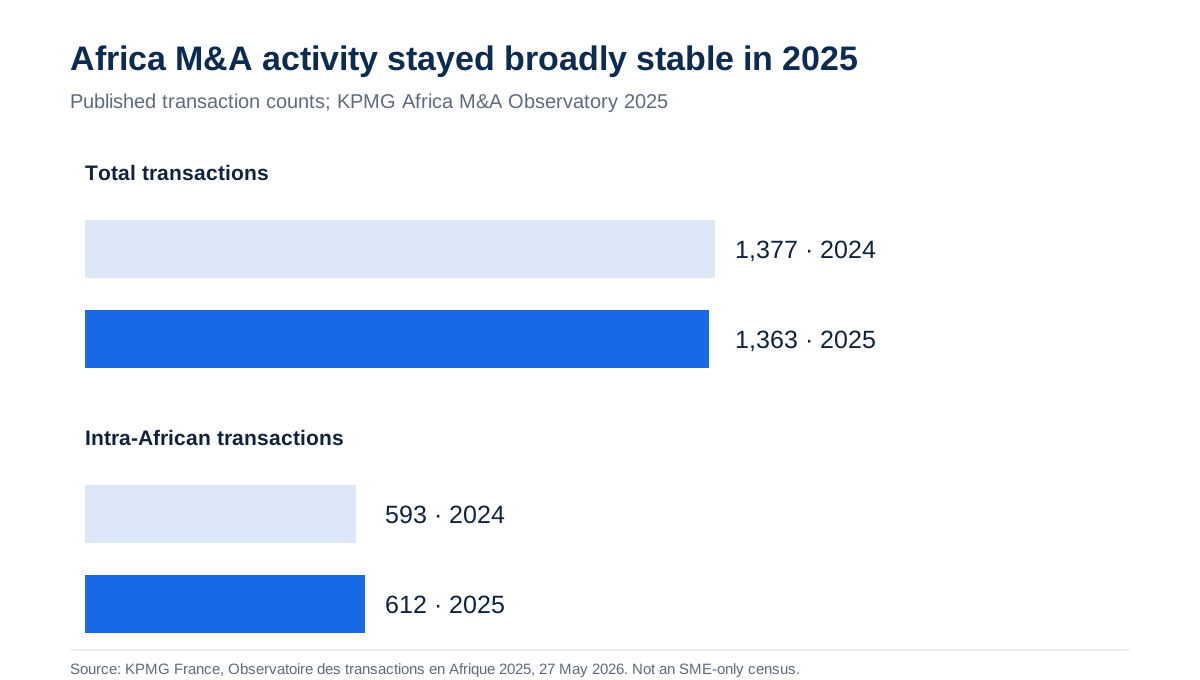
KPMG recorded 1,363 African M&A transactions in 2025, compared with 1,377 in 2024, a decline of about 1%. That does not describe a collapsing market, nor does it support a claim of broad-based exuberance. It points to a market that remains active while investors apply greater discipline to capital allocation in the face of funding costs, currency volatility and execution risk.
KPMG also recorded 612 intra-African transactions in 2025, up from 593 in 2024. Southern Africa remained the largest region by transaction volume, while North Africa posted the strongest regional increase, at 23%.
Those figures are useful indicators of transaction climate. They should not be converted into a claim they do not support: the dataset is not presented as a complete census of African SME ownership transfers by company size, deal value and jurisdiction.
Africa M&A activity 2024-2025
The first analytical mistake is to treat all M&A data as SME market size
The public sources reviewed for this note do not provide one authoritative database capturing every SME sale, family succession, MBO/MBI, strategic acquisition, asset sale and confidential private transaction across Africa.
There are three reasons to be careful.
First, smaller confidential transactions are naturally less visible in professional databases. Second, SME definitions vary by country and institution. Third, statistics frequently used alongside M&A measure different phenomena: foreign direct investment, greenfield projects and listed-market liquidity describe the broader capital environment, not the number of SME ownership transfers.
For DealPME, this distinction is strategic. A missing common dataset is itself a market fact. It strengthens the case for progressively structuring evidence from mandates, qualified counterparties, diligence activity and validated outcomes instead of pretending that a fully measured SME M&A market already exists.
International capital remains present, but concentrated
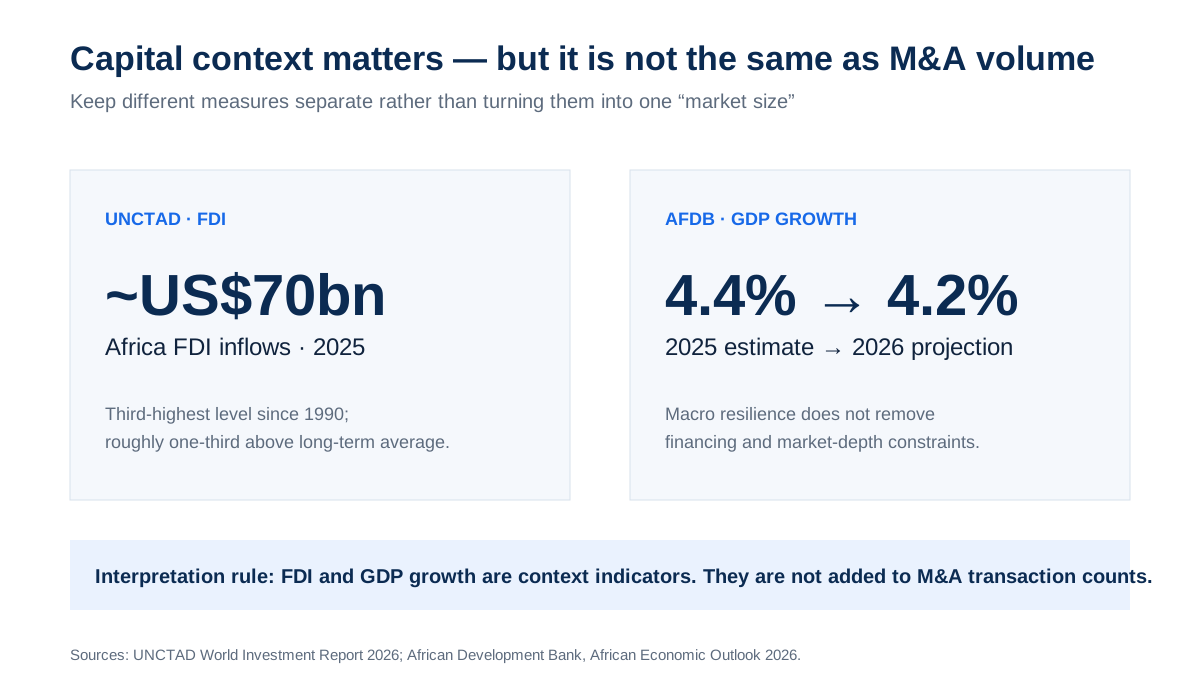
UNCTAD reports that Africa attracted about US$70 billion of FDI in 2025. That was below the exceptional 2024 level, but still the continent's third-highest level since 1990 and roughly one-third above its long-term average.
FDI is not M&A. It does, however, show how international investors are allocating capital across economies and sectors. UNCTAD also reports that the value of announced African greenfield projects fell by almost one third in 2025 even as the number of projects increased. The useful interpretation is not that more FDI automatically produces more SME buyers. It is that investors remain engaged while becoming more selective about how much capital they commit to individual projects and sectors.
For an SME, access to that capital depends on whether the business is understandable, documented and financeable.
Capital and growth context
Resilient growth does not remove the financing constraint
The African Development Bank estimated average African growth at 4.4% in 2025 and projected 4.2% for 2026. That macro picture supports the case for continued economic opportunity despite geopolitical and financial pressure.
Yet the Bank also highlights persistent financial fragmentation. Its 2026 African Economic Outlook reports that the value of stocks traded in African equity markets was about 4.4% of GDP in 2024, compared with roughly 120% globally, with activity concentrated in a relatively small number of exchanges.
That statistic concerns public equity markets, not private SME acquisitions. But it illustrates a broader financing constraint: in many African markets, buyers cannot rely on deep, standardized pools of capital. Transactions may need to combine buyer equity, bank debt, guarantees, seller financing or investor capital.
What this means for a seller
The data do not mean that a seller has “1,363 potential buyers”. The practical message is that selective capital rewards businesses that are easier to understand and execute.
Before approaching the market, a seller should be able to answer four questions.
Do the financial statements explain underlying performance and reconcile across periods?
Are ownership, authority to sell, shareholder arrangements and material restrictions documented?
Are major dependencies, customers, key people, suppliers, licences, contracts, disputes and capital needs, visible before a buyer discovers them independently?
Is there a deliberate confidentiality sequence, rather than an uncontrolled release of sensitive information?
Preparation does not remove transaction risk. It reduces the number of avoidable surprises that damage trust, timetable or value during diligence.
What this means for a buyer
A more selective market also raises the standard for buyers. A credible acquirer should be able to articulate a clear acquisition thesis, geography and sector, realistic funding envelope, source or path to financing, decision timetable and post-acquisition capability.
That preparation prevents two costly errors: spending months on businesses that do not fit the strategy, and negotiating price before knowing whether the financing structure can support the transaction.
Regional capital changes sourcing logic
The increase in intra-African transactions matters particularly for Francophone Africa. It is a reminder that the next credible counterparty may not be a global private-equity fund or a European strategic buyer.
It may be a regional corporate expanding geographically, an entrepreneur executing an MBI, an African family office, a diaspora investor or an industrial player from a neighbouring market.
That makes regional corridors, interoperable documentation and regulatory portability more important. OHADA creates a common business-law framework across its member states, but it does not make national tax, labour or sector rules identical.
Information quality becomes a transaction advantage
IFC notes that MSMEs account for more than 90% of firms globally and that the financing gap in emerging markets and developing economies remains measured in trillions of dollars. Those are global/EMDE statistics, not Africa-only numbers. Their relevance to transactions is that smaller businesses often present less standardized information than large public companies.
Transaction readiness therefore has practical value. A business does not need to be perfect to be sellable. It needs to be explainable: known gaps, available evidence, visible risks, assigned remediation owners and controlled sensitive information.
That should not be confused with automatic certification. In the DealPME model, transaction preparation and Deal-Ready certification are distinct: preparation is an execution discipline, while certification remains a human institutional decision within its defined scope.
Five operating conclusions for 2026
1. Do not use African M&A volume as an SME TAM. It is a market-activity indicator, not a complete SME-transfer census.
3. Seller preparation is market infrastructure. Reconciled evidence and controlled disclosure determine how quickly a business can become analysable.
4. Buyer credibility must be structured too. Identity, authority, thesis, financial capacity and timetable should be qualified before sensitive access.
5. The real proprietary dataset begins with documented transactions. Over time, anonymized evidence on mandates, buyer demand, cycle time, withdrawal reasons and completed outcomes can improve market intelligence.
What to monitor next
The next update should track published transaction activity and intra-African deal counts; Francophone Africa where methodology permits; financing conditions; SME credit availability; and, only once statistically meaningful, DealPME's own anonymized conversion from mandate to NDA, VDR, LOI, diligence and validated outcome.
Conclusion
The 2025-2026 evidence does not describe an easy African deal market. It describes one that is active, increasingly regional and more demanding on execution.
For sellers, that increases the value of early preparation. For buyers, it increases the value of a disciplined thesis and credible financing. For institutions and platforms, it increases the value of better transaction evidence.
The next competitive advantage in African SME M&A is unlikely to come from publishing more listings. It will come from helping credible businesses and credible buyers move from confidential intent to documented execution.
Sources and limitations
KPMG figures refer to its African transaction universe, not SME-only deals. UNCTAD FDI and greenfield figures are used as capital-allocation context and are not added to M&A counts. AfDB figures provide macro-financial context. IFC MSME figures are global/EMDE where stated. This article is educational and does not constitute investment, legal, tax or valuation advice.
References
KPMG France, Africa M&A Observatory 2025, 27 May 2026, https://kpmg.com/fr/fr/insights/conseil-financier/marche-africain-2025-ma.html
UNCTAD, World Investment Report 2026 and Africa regional release, 7 July 2026, https://unctad.org/news/africa-attracting-investment-strategic-industries-challenge-turning-it-broader-industrial
African Development Bank, African Economic Outlook 2026, 26 May 2026, https://www.afdb.org/en/knowledge/publications/african-economic-outlook